




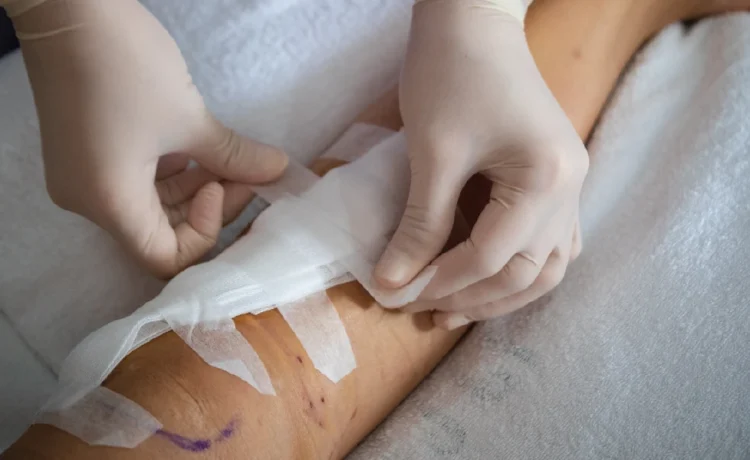
Whether it’s a clean surgical cut or a chronic pressure injury that’s persisted for months, every wound follows the same fundamental biological process. However, the real key to effective, evidence-based wound care – rather than mere guesswork – lies in accurately identifying which of the Stages of Wound Healing a wound is currently in. Applying the wrong dressing or treatment for a given stage can noticeably delay recovery, sometimes substantially. This is exactly why the ability to assess the Stages of Wound Healing accurately remains a fundamental, indispensable nursing competency across virtually every clinical setting.
Stage 1: Hemostasis
Immediately following any tissue injury, the body initiates hemostasis – the rapid clotting process that stops active bleeding and forms a temporary protective barrier at the wound site. Platelets quickly aggregate at the site of injury, and the clotting cascade forms a stabilizing fibrin clot that both seals the wound and provides a physical scaffold for the healing processes that follow. This initial phase typically lasts anywhere from minutes to a few hours and effectively sets the stage for everything that comes afterward.
Stage 2: Inflammatory Phase
The inflammatory phase follows next, generally lasting several days, as the body’s immune system actively works to clear cellular debris and any invading pathogens from the wound site. Neutrophils and macrophages migrate to the area to remove dead tissue and bacteria, and the classic, textbook signs of inflammation – redness, warmth, swelling, and mild to moderate pain – appear as part of this entirely normal and genuinely necessary process. Excessive, prolonged, or unusually intense inflammation, however, can signal a developing infection or a more general impairment in the healing process that warrants closer attention.
Stage 3: Proliferative Phase
Next comes the proliferative phase, during which the body actively rebuilds new tissue at the wound site. Fibroblasts produce fresh collagen, new blood vessels form through a process called angiogenesis, and granulation tissue gradually fills in the wound bed, followed by epithelialization spreading across the wound’s surface. This phase can last anywhere from several days to a few weeks depending heavily on the wound’s original size and depth, and it’s the phase where much of the visibly apparent “closing” of a wound actually happens.
Stage 4: Remodeling and Maturation
The final stage, known as remodeling or maturation, can continue quietly for months, and in some cases for well over a year after the wound first appeared closed. Collagen fibers gradually reorganize and strengthen over this extended period, and the wound slowly regains a meaningful degree of tensile strength – though resulting scar tissue never fully reaches the original strength of undamaged, healthy skin. Understanding clearly that remodeling is a long, genuinely gradual process helps set realistic expectations for both clinicians and patients regarding eventual scar appearance and strength over time.
Factors That Delay Wound Healing
Several common factors can significantly derail this normal healing progression at any stage: diabetes meaningfully impairs both circulation and immune function; active infection prolongs the inflammatory phase indefinitely, sometimes stalling healing entirely; poor tissue perfusion starves the wound of the oxygen and nutrients genuinely needed for repair; and inadequate nutrition, particularly deficiencies in protein and vitamin C, meaningfully limits the body’s underlying ability to synthesize new tissue. Identifying and proactively addressing these specific barriers is often considerably more important to overall healing than any single specific dressing choice made at the bedside.
Wound Assessment and Dressing Selection by Stage
Accurate, consistent wound assessment – measuring wound size precisely, describing the wound bed’s tissue composition, checking carefully for early signs of infection, and correctly staging any pressure injuries present – determines which stage a given wound is currently in and, therefore, which interventions and dressing types are genuinely appropriate to use. A moist wound environment generally supports the proliferative phase most effectively, while heavily draining or clearly infected wounds may require an entirely different dressing strategy altogether. Matching the chosen intervention carefully to the wound’s current stage is really the core, foundational principle underlying all evidence-based wound care.
Pressure Injury Staging
Pressure injury staging deserves particular attention within this broader framework, since staging directly reflects tissue depth rather than healing phase alone, and correctly identifying a Stage 2 versus a Stage 3 or 4 pressure injury has real implications for treatment planning, documentation accuracy, and even regulatory reporting in many care facilities. Consistent, well-trained staging practices across a nursing team reduce variability in how wounds are described and treated, which matters both for individual patient outcomes and for facility-wide quality metrics.
Clinical Scenario: A Wound Stuck in the Inflammatory Phase
Consider a chronic wound that appears to be “stuck” in the inflammatory phase for weeks rather than progressing normally into the proliferative phase – persistent redness, ongoing drainage, and a wound bed that never quite develops healthy granulation tissue. Rather than simply changing dressings on a fixed schedule, an effective nursing approach investigates why the wound is stalled: Is there an underlying infection that hasn’t been identified? Is the patient’s nutritional intake inadequate to support tissue synthesis? Is uncontrolled blood glucose impairing the immune response needed to move past inflammation? Identifying the root cause of a stalled healing trajectory, rather than treating the visible wound in isolation, is often what finally gets a chronic wound moving toward closure.
Continuing Education on Wound Healing Stages
The Wounds: Stages of Healing course walks through each of these phases with practical visual assessment guidance and clear dressing selection principles, and is offered as one of several certified nursing courses online built specifically for nurses managing wound care across acute care, long-term care, and home health settings alike. Recognizing exactly where a wound sits in its healing journey – and what’s realistically needed to help it move forward – remains one of the most practical, immediately applicable skills a nurse can bring to daily patient care.